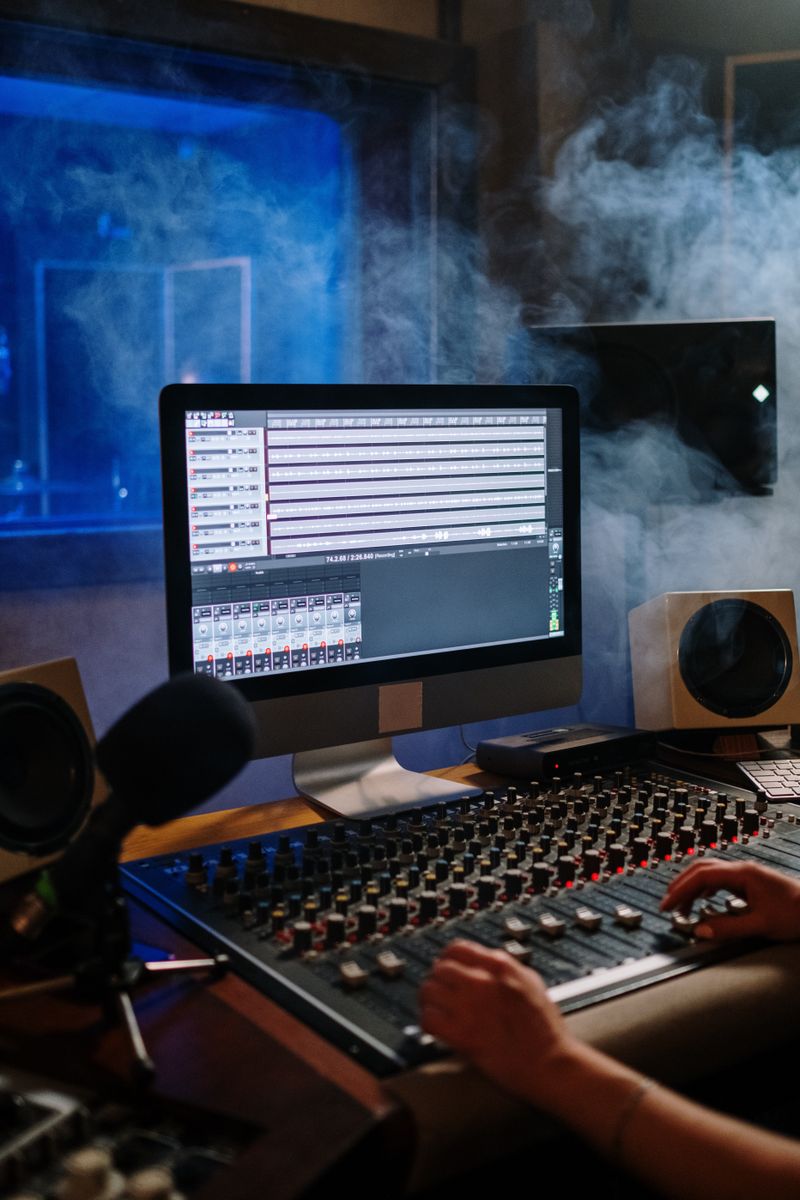

They record the song, it sounds spectacular in the studio, and then they listen to it on their phone headphones… and something is off. The bass crushes everything. The vocal gets lost. In the car it sounds strange. On computer speakers, different again. This is the most common problem we see at LAI Music when artists arrive with recordings made elsewhere.
The problem is almost always the same: poor or missing mixing and mastering. This guide explains exactly what each process is, why it matters and how to make sure your music sounds good on any playback system.
Mixing vs. mastering: the difference every artist must understand
These two terms get confused constantly, even among artists who have been in the industry for years. They are distinct processes, with distinct goals, carried out in sequence.
What is mixing?
Mixing is the process of combining all the individual tracks of a recording — lead vocal, backing vocals, kick, bass, synths, effects — into a single balanced and coherent stereo file. The mix engineer uses:
- Equalizers (EQ): To define each element's space in the frequency spectrum. Bass lives in the low end, the vocal in the upper mids, the hi-hat in the highs. If several elements compete for the same space, the result is mud.
- Compressors: To control the dynamics of each element and of the whole. An uncompressed vocal jumps from very soft to very loud; with compression it stays stable and present.
- Reverb and delay: To create a sense of space. A completely dry vocal sounds artificial; too much reverb sounds diffuse. Balance is what lets a song "breathe".
- Panning: To place each element in the stereo field. Not everything can sit in the centre; that distribution creates width and depth.
- Automation: Dynamic changes over time. The chorus volume lifting, the effect that only appears in the bridge, the vocal moving from left to right in the transition.
A finished mix is a stereo file at moderate volume, with enough headroom for mastering afterwards. It is not the final product.
What is mastering?
Mastering takes the stereo file from the mix and prepares it for distribution across every platform and format. Its goals are:
- Competitive loudness: So your song sounds as loud as the songs on the playlists you want to appear on, without distortion.
- Tonal consistency: Making sure it sounds good on every kind of playback system: cheap headphones, Bluetooth speakers, cinema systems, studio monitors.
- Meeting technical standards: Every platform has specific requirements. If your file does not meet them, the platform will normalize it — usually downwards — affecting the listener's experience.
- Final format: Preparing files in the right formats: WAV for distribution, MP3 for previews, and so on.
Loudness standards by platform: what you should know before mastering
This is the most technical aspect and also the most ignored. Every streaming platform has a target loudness level to which it normalizes all songs. If your master exceeds that level, the platform turns it down. If it falls below, it can sound quieter than the competition.
The industry debate over whether to master "hot" (very loud) or to respect each platform's limits has been running for years. The current position of most professional engineers is clear: master for the main platform of your audience, make sure the True Peak does not exceed -1 dBTP, and let the platforms do their normalization work without forcing it.
The full process: from stems to distribution
Step 1: Export the stems from the production
Before the mix engineer can work, they need the stems: the audio files of each separate track. A well-organized stem pack includes at least:
- Lead vocal
- Backing vocals and harmonies
- Kick and bass drum
- Snare and percussion
- Hi-hats and cymbals
- Bass (808 or acoustic bass)
- Melodies and synths (layer by layer)
- Effects and transitions
All the stems must be exported at the same tempo, at the same resolution (24-bit / 44.1kHz minimum) and from the same start point (sample 0). A badly exported stem pack can cost the engineer hours of extra work — and the artist extra money.
Step 2: The mix session
At the recording studios in Medellín where we operate, a professional mix session for a 3 to 4 minute single takes between 4 and 8 hours of actual engineer work. That is without counting revisions — usually 2 or 3 rounds of minor corrections before reaching the approved mix.
What a good mix engineer does is not only balance volumes. It is making artistic decisions about which elements lead at each moment of the song, how to create tension and release through the audio, and which effects reinforce (rather than distract from) the emotion the lyrics are trying to convey.
Step 3: Revisions and mix approval
The most common mistake here is listening to the mix on only one kind of system. Listen to your mix on:
- Wired headphones (no processing)
- Portable Bluetooth speakers
- A car sound system
- Computer or TV speakers
- Consumer wireless earbuds (AirPods, etc.)
If it sounds good in all of those contexts, the mix is good. If it noticeably "fails" in one of them, there is something to fix.
Step 4: The mastering session
Mastering at a professional-level music production company in Colombia is done with calibrated monitors in an acoustically treated room. The mastering engineer works with the approved mix — not the stems — and the work usually takes between 1 and 3 hours per song.
At the end they deliver: the master WAV file (for distribution), a high-quality MP3 (for social media use and previews), and in some cases the platform-specific files (Spotify, Apple Music, YouTube, etc.) already optimized.
Mixing and mastering together or separately?
In the Colombian and Latin American market, many studios offer both services together at a discount. The advantage is convenience and stylistic consistency — the same team that mixed also masters, so they know the sonic context.
The disadvantage is that a pair of "fresh ears" at the mastering stage can spot problems the person who mixed can no longer hear. Artists who are most careful with their sound often separate the two processes: one engineer for the mix, another for the master.
"There is no more honest ear than the one hearing your mix for the first time. That is why the mastering engineer is the last line of defence before the world hears your music."
Signs of a good mix: a checklist
Before approving your final mix, check that it meets all of this:
- The lead vocal is intelligible on every playback system without adjusting the volume.
- The bass is felt (not just heard) on speakers with some subwoofer.
- The percussion elements have attack and presence, not just noise.
- The backing vocals enrich without covering the lead.
- The song has dynamic movement: the chorus feels bigger than the verse.
- There are no frequencies that "punch" or hurt when you listen at moderate-to-high volume.
- The stereo image is wide without losing mono compatibility (it does not disappear on a single centre speaker).
Why LAI Music integrates production, mixing and mastering
At our music production company in Medellín, the engineer who produces the beat works in direct communication with whoever does the mix. That avoids surprises: from the production stage we know how the final result will sound, which frequencies we have available for the vocal and how much space we leave in the spectrum for everything to breathe.
The result is music production in Colombia integrated from start to finish, where every technical decision serves the artistic vision. That is how LAI Music artists have accumulated more than 360 million views on YouTube without a major label or a million-dollar budget.
Want to know the real costs of this whole process? Read: How much does it cost to record a song in Colombia in 2026?
Want to understand how a complete music production company works? Read: Music production in Medellín: how a real record label works in Colombia.